Choosing a local model for a 16 GB Arc A770: 71 models checked, and why we keep our own
We checked 71 models that could replace our local coding model on one 16 GB Intel Arc A770, and kept our own Qwen3.8-27B. What we learned that applies to any 16 GB card: check the quant types inside a file before you download it, where 'shared memory' really goes, why prefill wants different kernels than decode, dense versus MoE at this size, and how far apart benchmark harnesses are. Every model we would test next is linked.
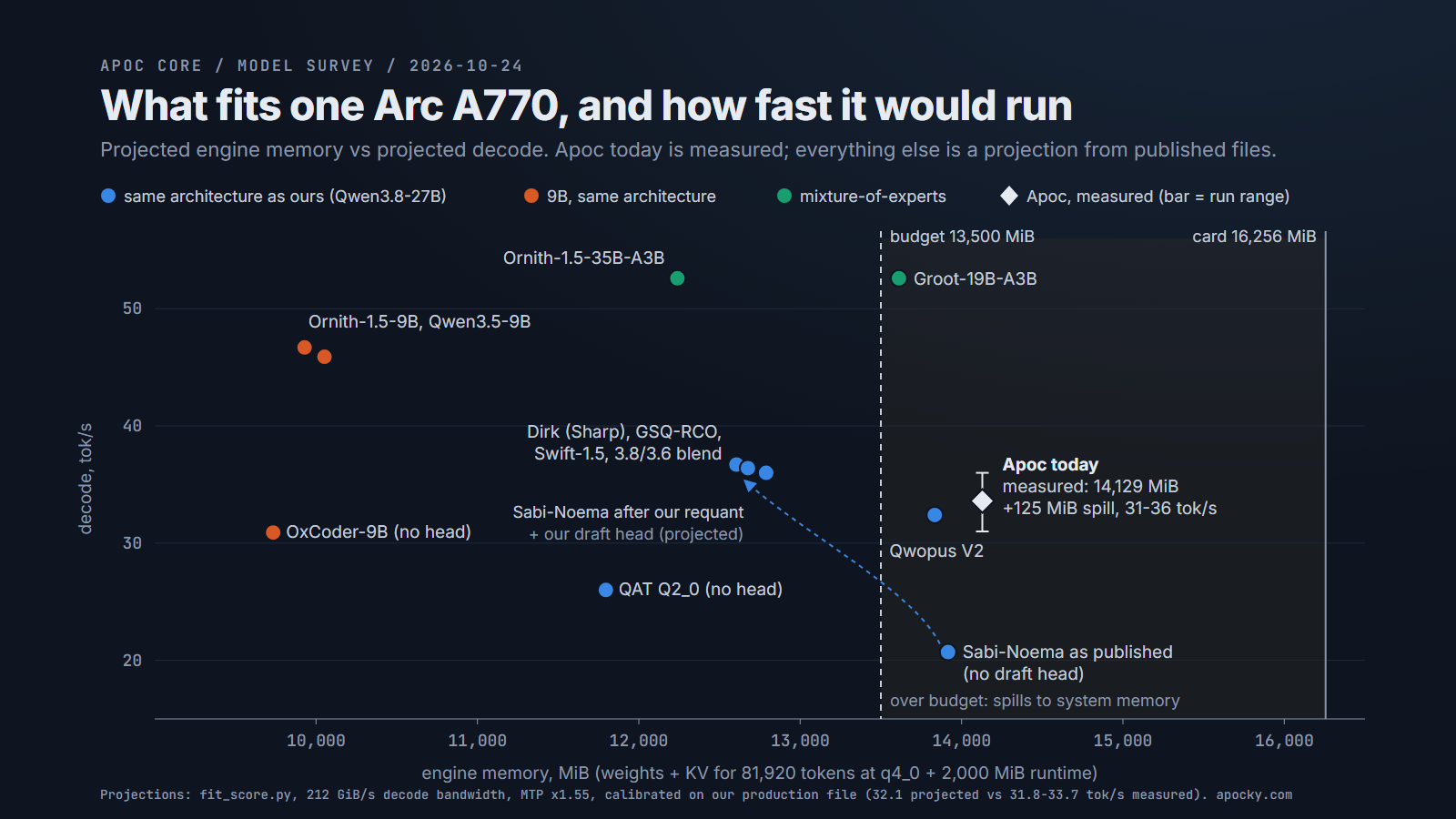
Apoc is the local model behind Apocrypha: Qwen3.8-27B in our own 2-bit mix, on one Intel Arc A770 with 16 GB. New models land every week, so we stopped and asked whether anything released up to today does the job better on this card, with all our tooling switched on. We checked 71 models from two survey passes (151 raw entries): big releases, small labs, and one-person fine-tunes.
The short version: keep our own model. Nothing beats it on this card once quality, fit and our tooling are counted together. The best moves either keep its weights (a chat template, a smarter trim, better kernels) or start from a fine-tune of the exact same model, so everything we built still applies.
The chart above is projections for everyone except Apoc. Projections come from our fit model, which is calibrated on the production file: it predicts 32.1 tok/s, and we measure 31.8 to 33.7.
What you can take from this
For anyone choosing or tuning a local model on one 16 GB card, especially an Intel Arc:
- Check which quant types are inside a file before you download it. On Arc with SYCL, I-quant files ran far slower than K-quant files (Q2_K to Q6_K). Our build ran a mostly-I-quant file at about 21 tok/s prefill against 195.5 on our K-quant file, and a reported Arc B60 test went from 8.1 to 22.2 tok/s decode after a K-quant requant. File names do not tell you: “IQ2_S” can be an 11-type mix, and “K_XL” does not mean K-quants only.
gguf-dumpfrom llama.cpp’s gguf package lists every tensor’s type. - “Shared GPU memory” is not always your model spilling. On our card all 125 MiB of it was pinned host staging memory. Setting
GGML_SYCL_ENABLE_HOST_PINNED_MEM=0(a documented llama.cpp SYCL setting) took it to 0 MiB. Together with a 4-bit draft cache and a smaller draft batch, the engine went from 125 MiB shared to 1 MiB and used 215 MiB less on the card, while prefill went from 178.6 to 194.6 tok/s and decode from 41.4 to 42.7 in a clean, mirrored A/B. - Prefill and decode want different kernels. ef777/a770-qwen-xe1 expands the weights to 16-bit once per batch and runs a library matrix multiply. With the same file and settings, it prefilled at 481.8 tok/s against our 199.7, while our decode stayed faster. If you run Qwen3.8-27B on an A770 and your work is mostly long prompts, that build is worth a look.
- At this size, dense wins on quality and MoE on speed. The 35B-A3B family runs at 52.6 tok/s on an A770 (third party), but in an independent 25-task SWE-bench-Live run the dense Qwen3.8-27B solved 16 against 8 to 12 for Ornith-35B-A3B.
- Treat small benchmark gains with suspicion. The same base model scores 73.0 in its maker’s table and 69.2 in a fine-tuner’s: the harness gap is as big as most claimed gains. Run candidates on your own tasks.
- Measured and dropped, so you can skip them: the output layer on the CPU (decode down 37 percent), 3 or 4 draft tokens instead of 2 (acceptance 0.57 and 0.48, slower), and contexts above 128k on this card (crash on the first request).
The day’s test diary is at the end of the post.
Update 2026-10-25: what changed after the last entry of the test diary at the end (details in the 2026-10-25 post):
- The “next” graft leads moved. The draft heads of Qwopus V2 and ThinkingCap were fetched and compared: all 15 tensors are byte-identical to the base model’s head (measured 2026-10-24 20:15), so neither vendor trained a head and there is nothing to graft from them. Sabi-Noema is still not run: its download stopped at about 45 GB of 51.0 GiB when work was paused.
- Spill and memory: still not at target. Three trims (300, 500, 700 MiB off the file) were scored against Q8_0 and none was deployed; the card still peaks at 14,381 MiB at 76k tokens against the 13,500 MiB target.
- The Sharp chat template now exists as a build (ours plus its terseness block, off by default, byte-identical with it off on 8 of 8 checks), but its A/B has not run, so that gate stays open.
- Engine speed: a new engine build was deployed 2026-10-25 02:08 and stochastic speculative decoding 11:29. On our prose test prompts decode went from 28.1 to 31.4 tok/s. The numbers in this post’s tables are from 2026-10-24 and were not re-measured.
Where Apoc stands
Our budget for the engine is 13,500 MiB: weights, KV for 81,920 tokens, and 2,000 MiB of runtime and compute. That leaves room for the Windows desktop (0.9-1.6 GB) and a margin. The fit model puts production at 13,916 MiB, 416 MiB over budget, which matches the spill we see. The load log names the buffers (model 10,064 MiB on the card, 398 MiB of token embeddings in system memory, KV 1,440 + 320 MiB, compute 101 + 74 + 74 MiB), but not which one is the 125 MiB. Later that day it turned out to be none of them: it was pinned host staging memory (see the diary at the end).
| Run (fresh process, adapter at scale 0) | Short probe | Real turn: prefill / decode / acceptance | Card / spilled |
|---|---|---|---|
| 08:25 new file (Apoc imatrix) | 36.0 tok/s | 187 / 31.0 / 0.79 | 13,909 / 125 MiB |
| 08:44 old file (control) | 34.7 tok/s | 187 / 33.6 / 0.89 | 14,123 / 125 MiB |
| 08:50 new file again (production since) | 32.4 tok/s | 188 / 33.6 / 0.89 | 14,115 / 125 MiB |
| 12:25 production after the adapter fix | 31.8 tok/s | 184 / 33.7 / 0.92 | 14,129 / 125 MiB |
The short answers
Can we just requant to about 9 GiB and stop the spill?
Not blindly. We measured exactly that on Kaggle: a 9.01 GiB recipe scored mean KL 0.6144 against the full-precision reference on 8,184 held-out Apoc tokens, against 0.5065 for our current mix. It even lost to our mix with the old generic imatrix (0.5595). It did decode 7.4 percent faster, so the trade is real speed for real quality. The spill is only 125 MiB. First we name its owner, then we trim a few hundred MiB on purpose, where our allocator says bits are cheap, and check KL again before shipping. (Later that day the owner turned out to be pinned staging memory, and switching pinning off removed the spill; the trims are in the 2026-10-25 post.)
Is Sabi-Noema worth it?
Yes, as the first model to test. It is our model, RL-tuned, so the quantizer, imatrix, KV setup, XMX kernels, trainer, draft head and CSL adapter all carry over. In its makers’ own harness it beats the base on Terminal-Bench 2.1 (76.0 vs 73.0) and DeepSWE (47.5 vs 38.5), with about half the output tokens. The catch is the evidence: self-run numbers from 2-3 runs, never replicated, no training disclosure, and no draft head in the checkpoint. Our plan: requant it our way, graft our draft head (the shapes are identical), then measure acceptance, the CSL canon rate, and Palimpsest against the current core.
Should the core become a mixture-of-experts model?
No. It trades quality for speed, and none of our tooling transfers. The 35B-A3B family does run fast on an A770 (52.6 tok/s decode, 561 tok/s prefill, third-party, short context). But in an independent 25-task SWE-bench-Live run, Qwen3.8-27B solved 16, the best requant of Ornith-35B-A3B 12, and plain Ornith 8. They only fit at 2-bit I-quants, which miss our XMX K-quant kernels, and draft heads made SYCL MoE slower, not faster. The CSL adapter, trainer and draft export are all built for the dense layout.
What about the 9B models?
A good second tier, not the core. Ornith-1.5-9B and OxCoder-9B share our architecture, fit with 3.5-3.8 GiB to spare, and project to about 46 tok/s with a draft head and 530-555 tok/s prefill. They score about 46-50 on Terminal-Bench 2.1, against 70+ for the 27B. The 27B and a 9B cannot share 16 GB, so a 9B tier means loading one and unloading the other, or a second card. The CSL adapter would need retraining for the smaller shapes.
Most promising models
Fit is projected engine memory and headroom against the 13,500 MiB budget. Decode is shown plain and with a draft head. Scores are as published by each maker unless marked.
Same architecture as ours
Sabi-Noema
RL fine-tune of Qwen3.8-27B on open-source RL environments. Same tensor shapes as our core; no draft head in the checkpoint.
after our requant + our head 12,605 MiB +895 · ~36.7 tok/s
- Terminal-Bench 2.1 76.0 vs 73.0, DeepSWE 47.5 vs 38.5, MCPMark 48 vs 36 (Sabi's harness)
- Median output 29.3K vs 65.3K tokens
- Every tool we have applies, including the CSL adapter
- Self-run, 2-3 runs, never replicated, no training disclosure
- No draft head: ours must be grafted or retrained
- LiveCodeBench v6 88.0 vs 89.7
- Its own MLA variant shrinks KV about 3.6x but drops to 65.9 and does not run in llama.cpp
Next: our requant with the Apoc imatrix, our head grafted, then acceptance, CSL canon rate and Palimpsest.
Dirk-Qwen3.8-27B ("Sharp")
Not a new model: our base requantized, with a fixed chat template, a terse system prompt and default thinking lowered from xhigh to medium.
- The template (Qwen-Sharp-Chat-Templates) works on our current core with no weight change
- 25 SWE-bench-Live tasks: 15 solved vs 16, at 20.1 vs 50.2 min median per attempt
- On another base the template alone cut answer tokens 5,393 to 2,217
- 25 tasks, one run each
- Medium effort may cost quality on hard tasks
- "high" effort is an alias for xhigh; the author says openly there is no fine-tuning
Next: step 0, the template on our current core.
Qwen3.8-27B GSQ-RCO
A requant of our exact model with per-tensor bit allocation: 8.95 GiB, 2.75 bits per weight, draft head included.
- Same model, so every tool applies
- LiveCodeBench v6 82.29 vs 85.71 at full precision
- Publishes its per-tensor allocation, which our allocator can reuse
- Almost all I-quants; our XMX kernels cover Q2_K-Q6_K only
- An I-quant build ran 8.1 tok/s on an Arc B60 vs 22.2 after a K-quant requant (reported)
- "IQ2_S" is a nickname for an 11-type mix including IQ1 tensors
Next: use its allocation as input to our own K-quant trim.
Swift-1.5-Qwen3.8-27B
RL plus on-policy distillation of our base, tuned to penalise overthinking.
- Vendor 5-seed: Terminal-Bench 2.1 72.13 vs 69.21, LiveCodeBench v6 81.71 vs 76.76
- Thinking tokens down 16-25 percent
- Sabi's harness puts it at 62.9 on Terminal-Bench 2.1
- Licence is free only up to US$1M annual revenue
- The base scores 69.2 in UkisAI's table and 73.0 in Qwen's: the harness gap is as big as the claimed gain
Next: licence check, then a K-quant arm on the Sabi pipeline.
Qwopus3.8-27B-Flash-V2
SFT on teacher traces, then GSPO RL, on our base.
- Claims draft acceptance 80.7 vs 66.1 percent for stock
- Case study: 640 s and 20 turns vs 1,390 s and 48 for the base
- Author-only evidence; trace provenance undocumented
- Does not fix the fit
- The acceptance claim is from V1 at Q5_K_M, not this file
Next: a one-hour acceptance check on our engine.
Qwen3.8/3.6-27B blend
A 50/50 weight interpolation of Qwen3.6-27B and Qwen3.8-27B, no training.
- 37 vs 39 of 100 tasks solved with 71 percent fewer output tokens
- Pure merge, full precision published, so we can quantize it ourselves
- Internal evidence on Apple silicon
- CSL adapter on merged weights is untested
- "K_XL" in a file name does not mean K-quants only
Next: proof that weight merging works on our shapes.
Qwen3.8-27B QAT Q2_0
A quantization-aware trained 2-bit checkpoint of our model, in the new Q2_0 type.
- 2.07 GiB smaller than our mix
- Top-1 agreement 93.3 percent on code, level with a file 1.1 GB larger
- Q2_0 postdates our engine base and has no SYCL kernel
- Tool-calling agreement is its weak slice (78.7 percent)
- The author says a better Q2_0 and a Q1_0 are in progress
Next: watch; a fair test needs a backport, a kernel and a head graft.
The 9B tier
Ornith-1.5-9B
Dense 9B on our architecture (24 DeltaNet + 8 full-attention layers).
- No porting except retraining the CSL adapter
- SWE-bench Verified 70.6 (vendor)
- Terminal-Bench 2.1 about 46 vs 70+ for the 27B
- A published head measured 0.54 acceptance, against our 0.89
- Whether the official file carries a draft head is disputed
Next: Palimpsest at Q6_K.
OxCoder-9B
Qwen3.5-9B distilled from agentic coding sessions.
- SWE-bench Verified 73.5, Terminal-Bench 2.1 about 50 (vendor)
- Full K-quant ladder: same kernels as our core
- Baselines copied from another card under other settings
- No draft head
- A 9B claiming 27B-class SWE-bench is a lead, not a result
Next: Palimpsest next to Ornith-1.5-9B.
Also in this tier: Qwen3.5-9B, the zero-risk baseline with its own draft head (10,052 MiB, 45.9 tok/s projected) but weaker scores, and MiMo-V2.6-Distill-Qwen-9B, whose distill dropped the draft head.
Mixture-of-experts, for completeness
Ornith-1.5-35B-A3B
256 experts, about 3B active, on the hybrid layout.
- Measured fast on an A770 by a third party
- 18 of 18 independent tool-calling runs
- Independent SWE-bench-Live: 8 of 25 (12 as a requant) vs 16 for our base
- Draft heads were slower on SYCL MoE; our tooling needs ports
Next: last and optional, a benchmark on our fork.
Groot-19B-A3B
Qwen3.6-35B-A3B cut from 256 to 128 experts and post-trained.
- Terminal-Bench 2.1 52.10 vs 43.82 for its parent
- One day old at survey time, vendor-only, over budget as published
Next: watch only.
Changes that keep our own model
| Change | What it buys | Where it stands |
|---|---|---|
| Name the 125 MiB, then a targeted trim | zero spill and margin under budget | measured the 125 MiB was pinned staging, now 1 MiB shared; trims scored, none shipped yet |
| Apoc imatrix | mean KL 0.5595 to 0.5065 at the same size | measured in production since 08:50 |
| Anchored recipe and recipe gate | a recipe file that matches production exactly | measured done |
| Sharp chat template | shorter thinking, about 2.7x faster solves (reported) | not tried, step 0 |
| Kernel work from ef777/a770-qwen-xe1 | prefill measured 481.8 vs 199.7 tok/s on our file at their settings | A/B done; the wide-batch path is being rebuilt in our fork, not yet measured |
| Vocabulary extension for CSL | 13.2 percent fewer tokens on 40 canon seeds | measured at the tokenizer; model eval running |
| Trained draft heads | higher acceptance in theory | measured two rounds, no live win |
| Hadamard-rotated KV | better 4-bit KV, maybe 3-bit K | planned; needs a SYCL port |
| QAT 2-bit trunk | 2 GiB smaller | watch; needs a new type and kernel |
| DFlash drafters | about 8 percent over native heads on CUDA | watch; CUDA only, newer engine |
| MLA attention | KV about 3.6x smaller | not feasible here; scores dropped |
Already measured and dropped: the output layer on CPU (decode down 37 percent), draft depth 3 or 4 (acceptance 0.57 and 0.48, slower), contexts above 128k (crash on the first request), and the blunt 9 GiB requant above.
What we can graft from other models
| Graft | Evidence | Status |
|---|---|---|
| Our draft head onto a same-shape fine-tune (Sabi-Noema, QAT trunk) | someone grafted a 9B head and distilled it back to working | idea with a reported precedent |
| A fine-tune’s draft head onto our trunk | claims of 78-82 percent acceptance on their own trunks | idea |
| Our head stored at Q4 instead of Q8_0 | 63.0 vs 63.6 percent acceptance on Apple M5 | reported |
| Arc-tuned quant mixes and published allocations | ready-made priors for our allocator | reported |
| Agentic-session calibration text | our own version already cut KL 9.5 percent | measured |
| Weight blending with a same-shape RL model | JetBrains: 71 percent fewer tokens at near-equal solves | reported |
| Sabi-Noema’s RL as a task vector on our weights | nobody has tried it | idea |
| Keep adapters unquantized | an f16 adapter beat its q8_0 copy by about 5 points | reported |
Test order
One variable per step, cheapest first. Palimpsest, our five-task quality set, is the gate every change must hold.
- STEP 0Sharp template on the current core. Gate: Palimpsest holds, fewer tokens per solve.
- STEP 1Name the 125 MiB (done: pinned staging, now 1 MiB), then a targeted trim. Gates: zero spill, decode 33+, prefill 180+, KL vs 0.5065.
- STEP 2Sabi-Noema with our grafted head. Gates: Palimpsest, CSL canon rate, live acceptance.
- STEP 39B tier: Ornith-1.5-9B and OxCoder-9B. Gate: 4 of 5 or better.
- STEP 4 / DONEKernel A/B against ef777/a770-qwen-xe1: their prefill wins, our decode wins. The wide-batch prefill path is being rebuilt inside our own fork.
- STEP 5 / OPTIONALMoE probe on our fork. Palimpsest only if it clears 33 / 180 tok/s.
The kernel step jumped the queue because it can lift every model above, ours included. We are not swapping in someone else’s engine: their build is a measuring stick, and anything that wins gets rebuilt inside our own fork, so we keep what theirs lacks (our XMX kernels for Q2_K-Q6_K, the reasoning budget, the CSL adapter path and our draft path).
Risks we keep in view
- A llama.cpp issue reports garbled output past about 2,000-token prompts on SYCL and Vulkan hybrids. Our fork survives 22,000-token turns; we re-check on any new hybrid.
- Upstream SYCL draft decoding was slower than plain decoding on this model, so our draft gains are specific to our fork.
- Harness gaps are as big as most claimed gains: the same base scores 73.0 in one table and 69.2 in another.
- Not checked yet: any of these models on our machine, MoE prefill at long context on SYCL, and independent replication of nearly every score.
Every number on this page is either measured by us (marked, or in the “Where Apoc stands” section) or reported by its source and projected by our fit model. The full survey, with sources for all 71 models, is in our private repository; every model featured above links to its own page.
Test diary, 2026-10-24
The log we kept while the tests ran that day. Times are Pacific.
- Survey frozen at 71 models. Production measured: 31.8-36.0 tok/s decode on short probes, 184-188 tok/s prefill on a real 22,679-token turn, 125 MiB spilled to system memory.
- The first kernel A/B lost its first arm. The engine launcher's GPU cleanup killed the test server, because it ignored the GPU lock the test held. Fixed: every tool now honors the lock. 9 of 9 checks pass, including a control that still reproduces the kill when no lock is held.
- Kernel A/B restarted: our build against the ef777/a770-qwen-xe1 build, six arms, production down while it runs.
- Arm 1, our build with production settings and no adapter: prefill 195.5 tok/s on a 12,000-token prompt (both runs), decode 45.5 and 45.0 tok/s on a 300-token code reply with draft acceptance 0.942. That decode is a short, predictable code reply, so it is not comparable with the 31-36 tok/s of real agent turns. The 125 MiB spill is there without the CSL adapter too, so the adapter is not what spills.
- Arm 2, the xe1 build on our file with our production settings: prefill 272.1 tok/s (+39 percent), decode 39.4 tok/s (13 percent slower than ours), 252 MiB less memory on the card.
- Arm 3, our build with their settings (batch 768, 8-bit KV, 16k context, 3 drafts): prefill 199.7 tok/s. Bigger batches do nothing for our prefill path; that is the design, not a setting.
- Arm 4, the xe1 build with their settings on our file: prefill 481.8 tok/s, 2.46x ours; decode 43.7 tok/s with 3 drafts, still below our 45.5. So their prefill claim holds on our card and our file, and it comes from a different way of doing wide batches (weights expanded to 16-bit once per batch, then a library matrix multiply), which we will rebuild inside our own engine. Their decode kernels do not beat ours. Arms 5 and 6 (their own Q3_K_XL file) are running; our build crawls on it at about 21 tok/s prefill because that file is mostly I-quants, which our fast kernels do not cover.
- Arm 5, our build on their Q3_K_XL file: about 21 tok/s prefill, as expected for a file that is mostly I-quants. We cut it at 295 seconds to bring production back sooner; the rate was already clear.
- Arm 6, their build on their own file: prefill 584.7 tok/s (they claim 610-690) and decode 36.7 tok/s (they claim 40-50). Production came back 22 seconds later, through the new launcher, with the CSL adapter at scale 0 as it should be. An independent critic pass over our kernel audit confirmed 13 of its 15 checked findings and corrected 2; one correction makes a planned attention fix worth more than we thought. Next: a second round of arms aimed at the 125 MiB spill, and two engine fixes (a faster slot restore, and a cache bug in CSL mode) built and tested.
- The CSL training run from this morning is scored, and it is not the regression it first looked like. Its adapter with the new vocabulary reached canon on 4 of 20 new prompts, against 1 of 40 for the first adapter on the same prompts, and it writes 16 percent fewer tokens than the base model. Details are on the CSL page.
- Spill, measured. All 125 MiB of shared memory is pinned staging: with pinning switched off the counter reads 0 MiB. An 8-bit draft cache frees 126 MiB on the card and a 4-bit one 196 MiB; the legacy memory pool costs 986 MiB more and is out. The rule from today: zero spill, always, and the engine at or under 13,500 MiB so the desktop can never push it out. This round's speed numbers do not count: other jobs were compiling on the CPU while it ran. A clean round, waiting for an idle CPU before each arm, decides which settings ship.
- A clean round, each arm waiting for an idle CPU and run twice in mirrored order, settled the spill settings. Pinning off costs nothing once nothing else is compiling. With pinning off, a 4-bit draft cache and a smaller draft batch, the engine uses 1 MiB of shared memory instead of 125 and 215 MiB less on the card, at 194.6 tok/s prefill and 42.7 tok/s decode against 178.6 and 41.4 before.
- Deployed to Apoc, with a rebuilt engine that also fixes a cache bug in CSL mode: after a CSL turn, the next ordinary turn could reuse memory computed with the CSL adapter. Checked live: 13,595 MiB on the card and 1 MiB shared after warm-up.
- A test replaying our longest real turn, about 54,000 tokens, crashed the engine at 53,566 tokens; it restarted on its own. The cause is in the engine: a scratch buffer for attention tried to grow while the GPU was recording a command graph, which is not allowed. The same spot hides a second bug, where a cached graph could later write into freed memory. Both are fixed in a new build, now being tested against a control that must still crash, and at 76,000 tokens of context.
- Crash fixed and deployed. The same 54,281-token turn now finishes; with the old behaviour switched back on, the test build still crashes at the same spot, so the test really exercises the bug. It finished a 76,027-token prompt too. At long context the new settings peak at 6 MiB of shared memory, where the old ones reached 229 MiB, so zero spill holds. The card itself peaks near 14,380 MiB, about 880 MiB over our 13,500 MiB target; most of the growth is a 16-bit copy of the attention cache that long prompts make, which is next to go.